
|
|
My V3 URL is: http://redirect.to/christmas
I got it for free at: http://come.to

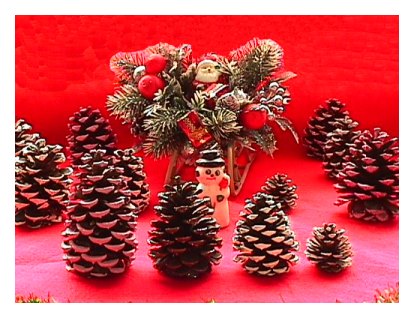
Welcome, we hope you've had and will continue to have a Merry Christmas. We are proud to be able to offer you Canadian Pacific Northwest Pine Cone Christmas Tree Ornaments. The pine cones are from old growth Ponderosa Pine well over 400 years old. These are native trees of Vancouver Island, specifically from the Tofino, Port Alberni, Qualicum Beach and Parksville old growth forest areas. The same virgin forests that greeted the first Europeans to visit the west coast. These forests are considered a sacred place by the Indians. The pine cones smell just like the fresh outdoors. They add a natural look, feel, and smell to Christmas that everyone enjoys. Great for enhancing your winter Christmas display. What a spectacular visual presence they are hanging from your Christmas tree. Fantastic as a Christmas gift. Makes an interesting conversation piece.
The pine cones are first sterilized to ensure both health and environmental integrity. They are cured and dried for 6 months. They average 2" to 8" in height. The tips of the pine cone are then given a colorful Christmas decor. Boxes come with 6 beautiful pine cones. You can ask for specific colors if you wish. We add a colorful string on the top so you can hang the decorated pine cone on your Christmas tree. These pine cone ornaments will last up to 100 years. Simply soak the pine cones in water once every year so they don't dry out. It's that easy to preserve them. Imagine, a product that lasts that long and the money you'll save on Christmas ornaments. Unheard of these days. Best of all the pine cones are totally natural and environmentally friendly.
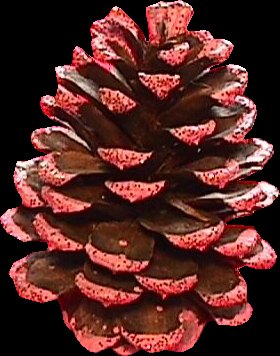
Colors come assorted in gold, red, white, blue, silver.
Sizes range 4" to 6" tall and 2" to 3" wide.
$20.00 per 6 pack
+ $5.00 shipping.
$37.00 per 12 pack
+ $8.00 shipping.
$70.00 per 24 pack
+ $10.00 shipping.
2 WAYS OF
EASY ORDERING

SECURE ONLINE
CREDIT CARD ORDERING


OR
MAIL ORDERING
USA FUNDS FOR ORDERS OUTSIDE
CANADA
SEND CASH or INTERNATIONAL MONEY ORDER
ORDER AMOUNT AND RETURN ADDRESS
Mail to:
B. Lafortune
c/o Pine Cones
Box 225 Cedar Road
Cedar, BC, Canada
V9X 1W1
EXPERIENCED WORLDWIDE SHIPPING.
PLEASE ALLOW 1 TO 3 WEEKS FOR DELIVERY.

PONDEROSA PINE
pinus ponderosa
UNIQUE FEATURES:
LOCATION:
SIZE:
 CONES:
NEEDLES:
BARK:
WOOD CHARACTERISTICS:
USES:
PINE TREES
Pine trees are conifers (evergreen trees) and reproduce using cones. They have both male and female cones. The male cones are small (2.5 cm) in length. The female cones are much larger and are made of woody scales. These woody scales in the cones contain the developing seeds. In spring the male cones make huge amounts of pollen. This pollen is carried by the wind to the female cones. The egg cells in the female cones are fertilized by the pollen from the males. The seeds mature in about two years. The mature seeds have winged parts that twirl and float in the wind. This allows the seeds to travel away to new locations where they try to grow. Although large quantities of seeds are produced, only a few ever grow into trees. Many seeds fall on areas where they cannot grow and others become food sources for a wide variety of birds and mammals.
PINE CONES
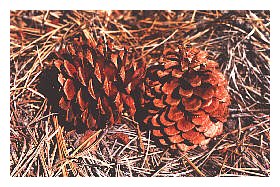
Cones are made up of scales attached to a center stalk. In between the overlapping scales the seeds can be found. The difference in cones can be seen by the scales. Pine cone scales are woody in nature, with a rigid feel. In contrast, spruce cones have thinner scales than pine cones, which gives them a less rigid feel. Rigidity varies greatly within the spruces. Length of cone is not a reliable way of differentiating one type from another; the length can vary greatly from tree to tree. The margins of the scales can be used to differentiate species of spruce and pine. In some species, the margins are entire and rounded as in the white spruce, while in others they are rough and notched as in the Colorado spruce. Some pine scales have a small prickle on each scale to further help identification. Most spruce and pine trees retain their cones for a few years; thus it is common to see new and old cones still attached to a tree. A number of pines will retain their cones for many years. Fir cones are erect, unlike the pendulous cones of most spruce trees. In fir trees, the scales on the cones are deciduous; that is, in the autumn, the scales fall off, leaving the erect center stem attached to the branch. You will see these erect center stems near the top of the fir tree. Though it won't help you to tell conifers apart, just for your information: the cones being discussed are the female reproductive portions of the tree. The male cones are formed in the spring near the branch tips and are often mistaken for reddish buds. These cones are short-lived. Female cones are produced in the summer and are not fertilized until the spring of the next year. The seeds can be shed later the same fall or are sometimes not shed for a few years. Most female cones are found near the top of the tree.